
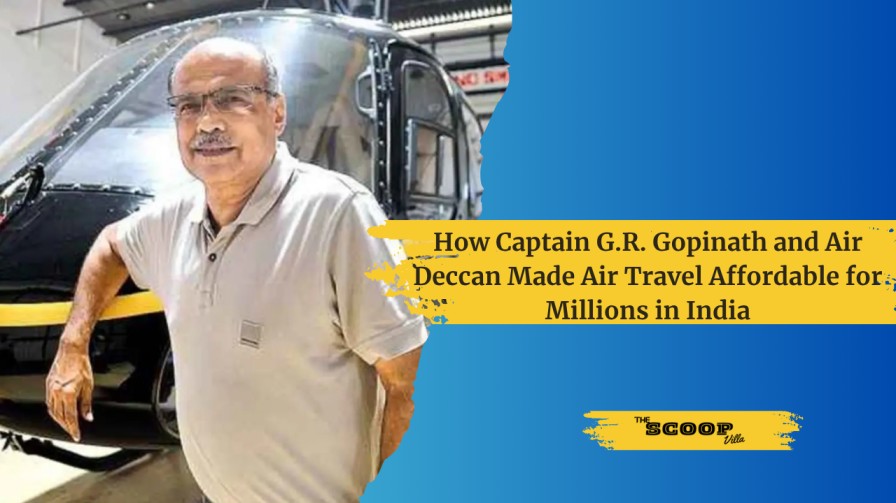
Captain G.R. Gopinath is a soldier. Or he was. Then he builds an airline. He calls it Air Deccan. It is cheap. The first of its kind in India. And it changes the way people see the sky. He speaks with Editor Vijay Grover. No grand talk. Just the truth. He tells how it starts—with a one-rupee ticket. That ticket becomes a spark. A small flame that catches in the hearts of millions. It makes flying real for people who never believed it could be.
In 2003, something shifts. Not slowly. It hits hard. One man, once in uniform, asks a question no one asked out loud before: “Why can’t ordinary people fly?” Before that, planes belong to the rich. The powerful. The men in suits and the ones behind desks. The rest watch from below. They do not dream of flying. Dreams cost too much.
But Gopinath does not believe in that. He sees something different. He sees wings on the backs of everyday people. He believes flying should not be rare. It should be like the road. Open. “The sky,” he said, “belonged to everyone.”
From Soldier to Sky Pioneer
Captain Gopinath’s story does not start in a tower or a high glass room. It begins in the dust and heat of the Indian Army. Out there, men live by grit and order. That is where he learns to endure. When he leaves the Army, he does not rest. In 1995, he starts a helicopter company. It is not common. Not then. Even the rich do not own choppers. They borrow them. India had fewer helicopters than Brazil. Fewer than Malaysia. He saw this. He saw a space. “I saw an opportunity,” he said.
His eyes sharpen with time. On visits to his village, he sees more than land and people. One day, a sign catches him—Computer School. It is nailed to a wooden board in a small village. He walks in. A boy teaches computers with one old laptop. The roof is tin. The room is bare. But the light is there.
“It was like watching the pulse of a new India,” he says. He keeps seeing it. Dish antennas rise from mud homes. Fridges sit like trophies in small living rooms. He knows what it means. These are not luxuries now. They are signs. India is dreaming. And it wants more.
An Airborne Revelation Over the Grand Canyon
Gopinath sat in a cramped seat on a Southwest flight, somewhere over the Grand Canyon. A tattooed carpenter from America sat beside him. Gopinath watched them and thought, If he could fly, why couldn’t the Indian mason or nurse? That was the moment it came to him.
Later, at Luton Airport in London, he watched the flood of passengers pass through. More than all of India’s airports combined. It hit him then—India didn’t lack people. It lacked vision. He went home. He would start an airline. He had no idea what an Airbus cost. That made him smile. Sometimes not knowing is good. “Overanalysing can paralyse you. Passion moves you forward,” he said.
Air Deccan Takes Off
https://www.instagram.com/p/CHiqLhkgN4m/?utm_source=ig_web_copy_link&igsh=MzRlODBiNWFlZA==
Starting Air Deccan was like walking through a minefield. The rules were heavy, the money was light, and the old hands in the business didn’t believe it could be done. But Gopinath kept going. “True vision is not collective—it’s deeply personal,” he said. “It’s something you carry alone. You believe when no one else does.” He wasn’t just chasing low fares. He wanted the skies open to all. The one-rupee ticket wasn’t for profit. It was a message. “It said, ‘You too can fly.’ That mattered more than anything.”
UDAN’s Missed Potential
Twenty years on, India talks of connecting its small towns by air. The UDAN scheme is in motion. Captain Gopinath watches with a mix of hope and doubt. “You can’t run a mobile network that only connects two cities. It’s the same for airlines,” he said. He spoke of small planes that cost too much to run, of good men and women leaving for better pay, of airports without the tools to guide planes in.
“Why spend crores on terminal buildings when planes can’t land after 4 pm?” he asked. He remembered Agra in 2002. A city with tickets printed and ministers on board. But the flights never came. No landing system. No truth. “It was all for show,” he said. “We need real investment, not facades.”
India’s Tourism Potential
Captain Gopinath draws a straight line from planes to tourists. “We have everything—forts, beaches, palaces, wildlife. And yet, Cambodia attracts more tourists than we do.” The fault isn’t in the land. It’s in how we show it. And how we plan. India has freedom, color, stories. But fear keeps travelers away. Dirt does too. “Even cities ruled by different parties suffer the same issues—overflowing garbage, weak infrastructure,” he noted.
He sees Indians running fine resorts in the Maldives and Mauritius. Back home, we struggle to bring in even a slice of Singapore’s crowd. “We’ve neither used our democracy like France nor planned like China,” he said.
Drive Is More Important than Profits
Air Deccan was no happy ending. This was sold, reshaped and gone. What it started still matters though. And building an airline was not just what Gopinath did. Something bigger started. He gave the sky to people. Money was never the issue. It was not for him. It was all about making the common man believe he is entitled to be in the air. He looks at the new players and feels like he has been let down now.
“They collapse as soon as subsidies end. They don’t have skin in the game,” he said. What keeps a venture alive, he says, is heart. “You must fly through the storm. That’s when you find your altitude.”
The Legacy of The Captain Who Made India Fly
Captain G.R. Gopinath didn’t just start an airline. He changed how a country thought. He opened the skies to a billion people—many who had never looked up before. His story is the story of an idea. It took guts. It took going against the grain. And in the end, it left something behind.
Air Deccan’s one-rupee ticket is now part of legend. But the mission still lives. It lives in the farmer’s boy flying for the first time. In the teacher heading to see the world beyond his village. Gopinath didn’t just help India fly. He made it believe it could.
Conclusion
Budget airlines now fight over luggage fees and charge for a window seat. Gopinath’s one rupee dream appears to be from another time. He proved to the country that flying was not just for men in suits. The airline he built couldn’t escape the pull of the market, though. It fell. But the dream did not come true. Every time a vendor’s daughter takes her first flight to Bangalore or a man from a small town flies to Mumbai in pursuit of something more than his savings, the legacy continues.
Boldness can beat caution, Gopinath showed. Sometimes you jump even if you do not know the price of the plane. India’s skies continue to tremble between hope and hardship. The man who gave wings to the poor did more than start an airline, but one truth stays. Belief was given to them. Belief has its value even when everything else goes up.
FAQs
Q1: Did people really fly for one rupee?
A: Yes, it would have been harder to find toilet paper at that price, though. It was pure theater with altitude, the one rupee ticket was not about making money. Gopinath used it as marketing masterstroke to show that flying was not just for suit wearing executives with expense accounts.
Q2: What happened to Air Deccan?
A: Air Deccan, like many beautiful dreams that meet harsh reality, got sold, reshaped and finally grounded permanently. The airline that democratized Indian skies could not survive turbulence of economics and competition. The thing is, its DNA survives in every budget airline.
Q3: Is Captain Gopinath still flying?
A: He is still soaring, just not literally, behind the controls of an aircraft. Nowadays he is more concerned about keeping India’s aviation sector from going into the doldrums of mediocrity and bureaucratic red tape.
Q4: Why did a soldier become an airline entrepreneur?
A: Apparently, you need to have the same survival skills to survive army life and aviation bureaucracy. Because of Gopinath’s military background, he learned discipline and resilience, qualities which would be needed to convince Indians, who were skeptical about flying, that it was not just for politicians and movie stars. His army training came in handy when he had to negotiate the minefield of starting India’s first low cost carrier, which everyone thought he was out of his mind to even start.


1
1vSDjj7iD
1*if(now()=sysdate(),sleep(15),0)
(select(0)from(select(sleep(15)))v)/*’+(select(0)from(select(sleep(15)))v)+'”+(select(0)from(select(sleep(15)))v)+”*/
1-1); waitfor delay ‘0:0:15’ —
1-1 OR 249=(SELECT 249 FROM PG_SLEEP(15))–
1JQNG6zPK’ OR 243=(SELECT 243 FROM PG_SLEEP(15))–
1c6uH5KCi’)) OR 15=(SELECT 15 FROM PG_SLEEP(15))–
1%2527%2522\’\”
1
1
1
1